
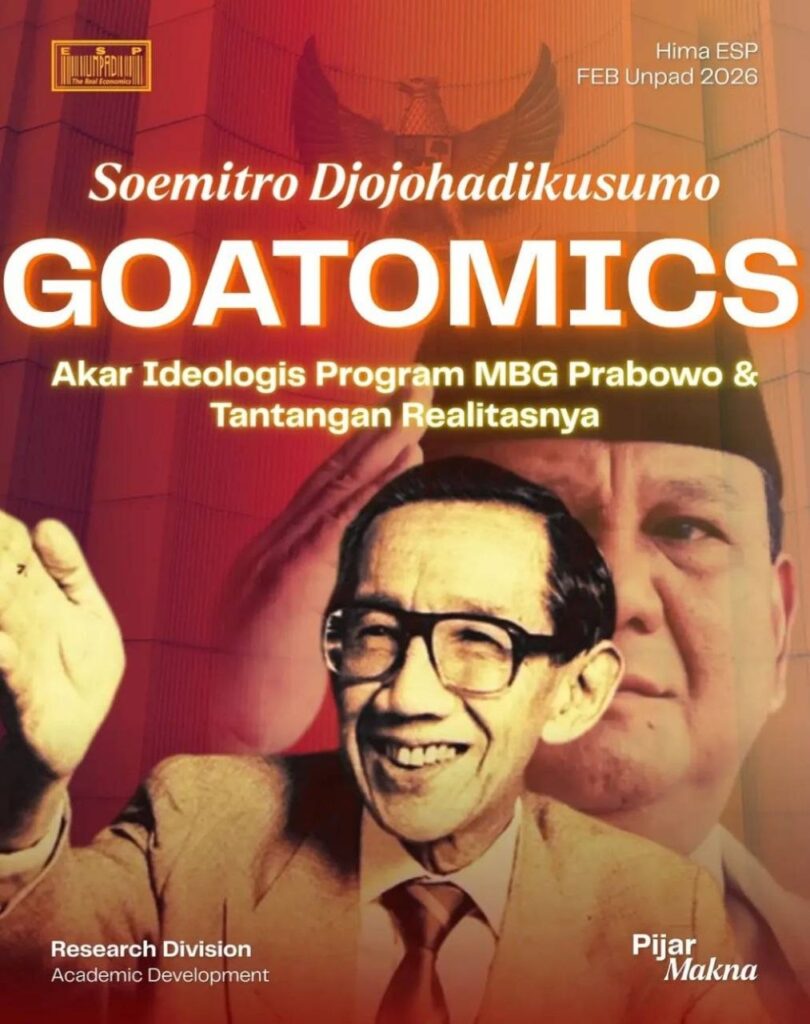
Soemitro Djojohadikusumo and the Ideological Roots of Prabowo’s MBG Program
How can a country as rich in natural resources as Indonesia still struggle to achieve true economic independence?
This contradiction is visible in everyday economic life: Indonesia exports raw materials, yet imports finished goods at much higher prices. Many local MSMEs struggle to compete with large corporations and foreign products. As a result, much of the added value in the economy is enjoyed outside the country, while domestic producers remain in weaker positions.
Beyond these visible symptoms lies a deeper structural issue: economic dependency.
Long before these problems became widely discussed, Soemitro Djojohadikusumo had already warned about the dangers of economic dependency.
“Political independence would never be complete without economic independence.”
For Soemitro, a nation could not truly be sovereign if its economy remained dependent on foreign capital, imported goods, and external industrial control.
Who’s Soemitro Djojohadikusumo?
For Soemitro, political independence was merely an empty gateway if it was not accompanied by economic independence.
Often referred to as the “Begawan of Indonesian Economics,” Soemitro was far more than a prominent public official. His distinguished career included serving as Minister of Trade and Industry, Minister of Finance, Minister of Research, and Dean of the Faculty of Economics at Universitas Indonesia.
As one of the principal architects of Indonesia’s modern economic development, and the father of President Prabowo Subianto, Soemitro consistently argued that a nation could never achieve full sovereignty if its economic lifeline remained dependent on foreign capital, imported goods, and external industrial control.
Within Soemitro’s framework, developing countries such as Indonesia would remain trapped in a cycle of underdevelopment if they relied solely on exporting raw commodities without building strong domestic industries. He emphasized three pillars that he considered essential for national sovereignty: industrialization, value creation within the country, and an economy controlled and developed by its own people.
The Benteng Program and Resistance to Foreign Dominance
A concrete manifestation of this vision was the Benteng Program, which Soemitro introduced during the early years of Indonesian independence. The program was designed to nurture an indigenous entrepreneurial class and reduce foreign dominance in trade and commerce by providing indigenous entrepreneurs with import licenses, access to credit, and other forms of government support to help them compete in the national economy.
Ironically, many of the economic challenges that Soemitro sought to address through the Benteng Program remain relevant today. Local businesses often find themselves in weak bargaining positions when dealing with large digital platforms and powerful corporate actors.
The Benteng Program demonstrated that Soemitro was not merely a theorist. He actively sought to translate his ideas into policies aimed at strengthening the position of indigenous entrepreneurs within the national economy.
Food Security and Economic Independence
For Soemitro, economic independence was not limited to factories and industrial development. It was also rooted in something far more fundamental: the food on people’s plates.
He understood that a country heavily dependent on food imports would remain vulnerable to global crises and market instability. When rice gradually became promoted as Indonesia’s primary staple food during the New Order era, creating the widespread belief that people had not truly eaten unless they consumed rice, Soemitro saw a potential long-term risk.
This growing dependence made national stability increasingly vulnerable to fluctuations in rice prices and supply disruptions.
As a result, Soemitro became a strong advocate of food diversification. He envisioned a more resilient Indonesia that could maximize the potential of local food sources such as cassava, corn, sago, and papeda.
In his view, food sovereignty and the protection of local farmers constituted the final line of defense for national sovereignty.
MBG as a Continuation of Soemitro’s Vision
This intellectual legacy may be reflacted in President Prabowo Subianto’s flagship program, Free Nutritious Meals (Makan Bergizi Gratis or MBG).
Viewed through a broader historical lens, MBG is not merely a food assistance program. Rather, it can be understood as a modern continuation of Soemitro’s vision of human-centered development.
Soemitro firmly believed that economic development must begin with people. A nation could not become truly sovereign if its future generations continued to suffer from malnutrition, low productivity, and unequal access to basic necessities.
Through MBG, economic nationalism is translated into a practical effort to improve human welfare from the dining table upward. The program seeks to strengthen human capital and enhance national productivity in the long run.
The Policy Drift: When Idealism Meets Reality
Despite its strong ideological foundation, the implementation of MBG has revealed several concerning challenges.
According to data from the National Nutrition Agency (BGN) and Statistics Indonesia (BPS), the program has shown notable inconsistencies in the accuracy of its distribution targets. If the primary objective of MBG is to reduce food insecurity and improve nutritional outcomes, interventions should be concentrated in regions experiencing the highest levels of food vulnerability.
However, field data suggests otherwise.
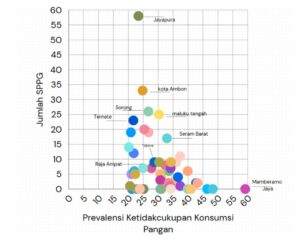
When mapping the relationship between the Prevalence of Food Consumption Inadequacy and the number of Nutrition Fulfillment Service Units (SPPG/MBG Kitchens), significant disparities become apparent.
For example, Jayapura receives a relatively large number of SPPG units despite exhibiting lower levels of food vulnerability than several other regions. In contrast, Mamberamo Jaya, which faces extremely high levels of food insecurity, receives little to no comparable support.
Similar patterns can also be observed in several vulnerable regions across Maluku and Papua.
Inequality in the Distribution of the MBG Program
This disparity in distribution serves as a serious warning that, in practice, the MBG program risks straying from its humanitarian mission. Instead of prioritizing regions facing severe food insecurity, assistance is often concentrated in areas that are relatively better off. As a result, the program’s substantial budget may fail to generate meaningful outcomes and could be used inefficiently.
Source: National Nutrition Agency (BGN), Statistics Indonesia (BPS)
From this, it is clear that the main challenge of the MBG program does not lie in its concept or ideological foundation. The legacy of Soemitro Djojohadikusumo’s human-centered economic thought remains highly relevant today. The real test lies in the hands of policymakers and program implementers. Ultimately, the true test of MBG lies not in the number of meals distributed, but in its ability to generate meaningful improvements in human welfare.
Soemitro Djojohadikusumo viewed economic development as a process of strengthening national capacity through productive and capable citizens. From this perspective, MBG can be understood as an investment in Indonesia’s future workforce. Better nutrition can lead to higher productivity, improved educational outcomes, and stronger economic competitiveness. However, these benefits will materialize only if the program reaches those who need it most. Without effective targeting and equitable distribution, MBG risks falling short of its developmental objectives.
Therefore, the implementation of the program must remain aligned with Soemitro’s broader vision: using state policy not merely to provide assistance, but to develop human capital, improve welfare, and strengthen the foundations of national economic resilience and sovereignty.
Reference
Babel Insight. (2025, Mei). KPK: Masalah tata kelola program makan bergizi gratis. Babel Insight. https://www.babelinsight.id/kpk-masalah-tata-kelola-makan-gratis
CNBC Indonesia. (2025, Desember 29). LPEM UI ungkap cara ayah Prabowo lepaskan RI dari ketergantungan ekonomi. CNBC Indonesia. https://www.cnbcindonesia.com/news/20251229093502-4-697827/lpem-ui-ungkap-cara-ayah-prabowo-lepaskan-ri-da
Direktorat Jenderal Perbendaharaan Kementerian Keuangan Republik Indonesia. (n.d.). Sumitro Djojohadikusumo: Begawan ekonomi Indonesia dan pemikir di balik fondasi pembangunan nasional. Media Keuangan. https://mediakeuangan.kemenkeu.go.id/article/show/sumitro-djojohadikusumo-begawan-ekonomi-indonesia-dan-pemikir-di-balik-fondasi-pembangunan-nasional
Jatim Times. (2024, Oktober 22). Mengenal Prof. Sumitro Djojohadikusumo, ayah Prabowo Subianto dan ekonom berpengaruh. Jatim Times. https://jatimtimes.com/baca/323441/20241022/174000/mengenal-prof-sumitro-djojohadikusumo-ayah-prabowo-subianto-dan-ekonom-berpengaruh
Kompas.com. (2022, Februari 23). Sumitro Djojohadikusumo, penemu sistem ekonomi Gerakan Benteng. Kompas.com. https://www.kompas.com/stori/read/2022/02/23/080000879/sumitro-djojohadikusumo-penemu-sistem-ekonomi-gerakan-benteng
Kompas.com. (2025, April 30). Kritik ICW untuk MBG: Hamburkan anggaran dan geser peran kantin. Kompas.com. https://nasional.kompas.com/read/2025/04/30/12330401/kritik-icw-untuk-mbg-hamburkan-anggaran-dan-geser-peran-kantin
Nahdlatul Ulama. (2025). Setahun MBG, peneliti ungkap distribusi hingga pengawasan masih bermasalah. NU Online. https://www.nu.or.id/nasional/setahun-mbg-peneliti-ungkap-distribusi-hingga-pengawasan-masih-bermasalah-71cUE
Suara Merdeka Jakarta. (2025). Soemitro Economic Forum dorong pemerintah perkuat pertanian untuk swasembada pangan. Suara Merdeka Jakarta. https://jakarta.suaramerdeka.com/ekonomi/13415295526/soemitro-economic-forum-dorong-pemerintah-perkuat-pertanian-untuk-swasembada-pangan
Warta IKN. (2025, Mei 28). Soemitronomics: Gagasan, langkah, dan pengaruh Soemitro Djojohadikusumo. Warta IKN. https://wartaikn.com/2025/05/28/soemitronomics-gagasan-langkah-dan-pengaruh-soemitro-djojohadikusumo
Wikipedia. (2026). Soemitro Djojohadikoesoemo. Wikipedia Bahasa Indonesia. https://id.wikipedia.org/wiki/Soemitro_Djojohadikoesoemo